
What Makes AI Infrastructure Valuable in Investment Research?
June 16, 2026
Introduction
Most discussions around AI focus on models, prompts, and productivity gains.
However, the most valuable AI businesses are increasingly being built around infrastructure rather than intelligence alone.
In investment research, the long-term advantage is rarely the model itself. It is the ability to embed AI into repeatable workflows, institutional knowledge, and decision-making systems that improve over time.
The question is no longer whether investment teams can access AI. The question is whether AI can be embedded into repeatable investment research workflows that improve decision-making over time.
The AI Model Is Becoming A Commodity
AI models are becoming increasingly accessible in much the same way that internet search became widely available during the growth of Google. As access expands, the competitive advantage derived from simply using AI may diminish.
We see the growth of OpenAI, Grok, Gemini, Mistral being used by professionals and everyday users. Moreover, the quality of these models continues to grow.
In relation to investment research, access to intelligence is no longer the bottleneck.
That is evident since investors, law firms, consultants are all accessing these AI models.
When all firms can access similar models, advantage shifts to workflow design, proprietary knowledge, monitoring, and execution discipline.
AI Infrastructure Creates Competitive Advantage
Historically, some of the most valuable technology companies did not create value solely through access to technology. Instead, they created value through infrastructure that allowed technology to be deployed at scale.
The internet created new opportunities, but search engines, cloud platforms, and enterprise software became valuable because they organized how people accessed and used information.
AI may follow a similar pattern.
As AI models become increasingly accessible, competitive advantage may shift toward infrastructure that organizes workflows, manages knowledge, monitors developments, and supports decision-making.
For investment teams, the long-term value may not come from simply having access to AI. It may come from embedding AI into repeatable investment research workflows that improve over time.
Infrastructure Creates Repeatability
Investment research is not simply finding information and that is it. Proper and professional investment research requires:
- sourcing information
- organizing information
- validating information
- generating conclusions
- tracking developments
An AI model can answer questions hence the value of AI increases when it becomes involved within a process.
Infrastructure creates repeatable outcomes by standardizing how information is gathered, analyzed, monitored, and transformed into decisions.
An example would be just manually prompting ChatGPT as an Analyst to develop a report on a company.
Manual AI usage is prompt-based.
Infrastructure is process-based and infrastructure creates:
- repeatable company screens
- consistent market maps
- comparable risk assessments
- structured investment committee outputs
- reusable research memory
This concept is explored further in our article on Structured AI in Investment Research Workflows, which examines how research organizations can move from ad-hoc prompting toward repeatable research systems.
Workflow Infrastructure vs Productivity Tools
A productivity tool helps individuals complete tasks faster.
Workflow infrastructure changes how work is organized, executed, monitored, and improved across an entire process.
For example, an analyst may use AI to summarize a report faster. While useful, the workflow itself remains unchanged.
Workflow infrastructure goes further by standardizing how opportunities are screened, how research is conducted, how risks are tracked, and how decisions are documented.
This distinction is important because infrastructure often becomes embedded within an organization’s operating model. As adoption increases, switching costs can rise and institutional knowledge can accumulate within the workflow itself.
Workflow Ownership Is Emerging As The Real Moat
There are many AI-native companies that are increasingly competing in relation to workflow ownership. A great example is Legal AI with companies such as Harvey, Legora, and Paxton competing heavily in this industry.
Recent evaluations of Harvey, Legora, and Paxton illustrate how workflow ownership is becoming a critical factor in assessing AI-native software companies.
The common objective across many AI-native companies is to become embedded within critical workflows such as research, due diligence, document review, and institutional knowledge management.
Harvey
Harvey illustrates how AI-native companies are increasingly competing around workflow ownership rather than model ownership. The platform combines legal research, document review, drafting, and workflow automation into a single environment designed to support legal teams throughout the lifecycle of their work.
As AI models become more accessible, Harvey’s long-term value may depend less on the underlying model and more on its ability to become embedded within legal workflows.
Legora
Legora’s positioning highlights the importance of collaboration and institutional knowledge within professional services workflows. By supporting document analysis, legal review, and team collaboration, the platform seeks to become part of how organizations manage and share knowledge.
This focus on workflow integration may prove more strategically valuable than access to any individual AI model.
Paxton
Paxton focuses on legal research, drafting, and professional workflow support. Its value proposition extends beyond answering legal questions and into helping professionals execute repeatable legal processes more efficiently.
Like many AI-native companies, Paxton’s long-term success may depend on becoming embedded within daily workflows rather than relying solely on model performance.
The strategic question is not which company has the best AI model. The better question is which company becomes embedded in the daily workflow of legal and investment professionals.
Recent Cohres commercial due diligence assessments of Harvey, Legora, and Paxton further explore how workflow ownership, institutional knowledge, and workflow infrastructure may influence the long-term value of AI-native companies.
Why Investors Should Care
Investors evaluating AI-native companies often focus on model capabilities, user growth, funding announcements, and revenue expansion.
While these factors remain important, workflow ownership may increasingly become a critical component of long-term value creation.
Companies that become embedded within important workflows can benefit from stronger retention, deeper customer relationships, greater accumulation of institutional knowledge, and potentially higher switching costs.
For investment teams conducting commercial due diligence, understanding workflow ownership may become just as important as evaluating product functionality or model performance.
Why Institutional Knowledge Matters
As in most things in life and business, systems need to evolve hence the most valuable research systems improve over time.
Institutional knowledge can include prior investment memos, commercial due diligence findings, customer interviews, market maps, investment committee decisions, expert network discussions, and lessons learned from both successful and unsuccessful opportunities.
Infrastructure allows these insights to compound over time. Without infrastructure, knowledge often remains trapped within:
- documents
- emails
- analyst notes
- old investment memos
- CRM notes
- diligence calls
- customer interviews
- expert network notes
- IC feedback
- prior rejected deals
The benefit of an infrastructure is that the research improves. The value of institutional knowledge is not only storage. The value is retrieval, comparison, and reuse across future decisions.
Commercial Due Diligence As A Workflow Problem
Commercial due diligence is often treated as a report, but it is more accurately understood as a workflow designed to evaluate whether an investment opportunity is supported by market realities, customer demand, competitive positioning, and sustainable growth assumptions.
The typical process includes:
- Market assessment
- Competitive analysis
- Customer validation
- Risk assessment
- Investment recommendation
Commercial due diligence is not simply a report produced at the end of a process.
Commercial due diligence exists to determine whether the assumptions supporting an investment opportunity are realistic. This requires evaluating market demand, competitive positioning, customer behavior, industry dynamics, growth opportunities, and potential risks.
Each stage of the process generates information that must be validated, organized, and integrated into an investment recommendation.
This is why commercial due diligence is better understood as a workflow rather than a report.
Examples of these workflows can be found in the Commercial Due Diligence & Investment Research Library, which contains investment research frameworks, commercial due diligence examples, and investment evaluation materials.
It is a structured workflow used to determine whether a company’s market, positioning, customer demand, competitive dynamics, and growth assumptions support the investment case.
The challenge is not information availability.
The challenge is coordinating information into a decision.
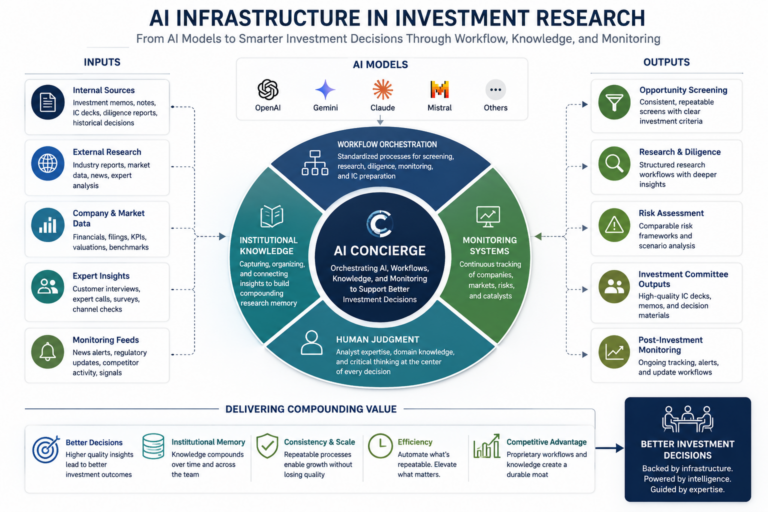
AI Concierge And Investment Research Infrastructure
Investment research is not a single task. It is a workflow that involves sourcing information, validating assumptions, monitoring developments, organizing institutional knowledge, and preparing investment recommendations.
AI Concierge is designed around the idea that investment research should function as an integrated system rather than a collection of disconnected tasks.
AI Concierge combines AI models, workflow orchestration, monitoring systems, knowledge management, and human judgment into a single research framework.
The objective is to create a research environment where information, workflows, monitoring, and institutional knowledge reinforce one another rather than operate in isolation.
Additional information about the framework can be found on the AI Concierge for Investors page.
For a detailed overview of implementation, see How AI Concierge Is Used In Investment Research, which explains how AI Concierge supports screening, monitoring, due diligence, and investment decision workflows.
The objective is not to replace analysts. The objective is to increase research capacity, improve consistency, and help investment teams focus their time on higher-value judgment and decision-making activities.
This approach becomes increasingly important as research organizations seek to scale knowledge, monitor more opportunities, and improve the quality of investment decisions.
The Future Of Investment Research Infrastructure
The future investment research stack will likely combine AI models, workflow orchestration, monitoring systems, knowledge repositories, investment committee preparation tools, and human oversight. Together, these components can help organizations create more scalable and consistent investment research processes.
The objective is not replacing analysts.
The objective is increasing research capacity and consistency.
The winning systems will not simply answer questions. They will help investment teams structure decisions.
Frequently Asked Questions
What Is AI Infrastructure?
AI infrastructure refers to the systems, workflows, monitoring processes, and knowledge repositories that allow AI to be deployed consistently within an organization. Infrastructure helps transform AI from a tool into an operational capability.
What Is Workflow Ownership?
Workflow ownership refers to a company’s ability to become embedded within how work is performed. Companies that own workflows often become difficult to replace because they influence how decisions, processes, and knowledge are managed.
What Is Institutional Knowledge?
Institutional knowledge consists of the accumulated insights, decisions, research, and experiences generated by an organization over time. Effective infrastructure allows this knowledge to be retained and reused.
What Is AI Concierge?
AI Concierge is an investment research framework that combines AI models, workflow orchestration, monitoring systems, knowledge management, and human judgment to support more scalable and consistent research processes.
Conclusion
The most durable AI businesses may not be those with the best model.
They may be those that successfully embed AI into workflows that become increasingly difficult to replace.
In investment research, infrastructure matters because it transforms isolated intelligence into repeatable decision-making systems.
As AI capabilities continue to improve, workflow ownership, institutional knowledge, and operational integration may become more important sources of competitive advantage than model access itself.
For Cohres, this is the role of AI Concierge: helping investment teams turn AI from isolated intelligence into structured investment research infrastructure.
This article is part of Cohres’ ongoing research into AI infrastructure, investment research workflows, commercial due diligence, and AI-native software companies. Related research includes assessments of Harvey, Legora, and Paxton, as well as the development of the AI Concierge framework for investment research.